First Cli-Met Workshop with Stakeholders Brings Metropolitan Climate Action to İzmir
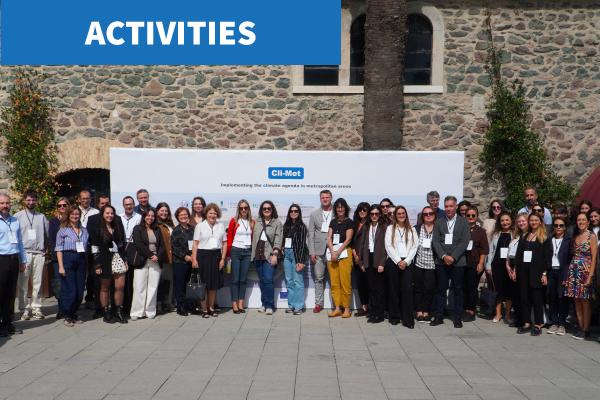
The first Cli-Met Workshop with Stakeholders brought together public authorities, researchers, practitioners and international partners in İzmir for three days of exchange, collaborative work and field-based learning on metropolitan climate action
Date: 28–30 September 2026
Venue: Tarihi Havagazı Fabrikası
Location: İzmir, Türkiye
Activity: Workshop with Stakeholders
Host partner: İzmir Metropolitan Municipality
THREE DAYS OF EXCHANGE, CO-CREATION AND EXPLORATION
The first Cli-Met Workshop with Stakeholders took place in İzmir from 28 to 30 September 2026, hosted by İzmir Metropolitan Municipality at Tarihi Havagazı Fabrikası.
Across the three days, the workshop connected metropolitan and district authorities, universities, professional organisations, civil society and international partners around a shared question: how can metropolitan areas translate climate objectives into effective local policies, institutional arrangements and practical action?
A total of 83 different participants signed the attendance sheets over the course of the workshop, reflecting a broad range of institutional and professional perspectives.
Day 1 – Exchange
The opening day brought together 74 participants, alongside Jorge Brito from the Metropolitan Region of Coimbra, who joined the international panel online.
Keynote and panel sessions explored metropolitan governance, climate policy and adaptation through experiences from İzmir and other European metropolitan areas.
The audience was strongly rooted in the local institutional context, with representatives from İzmir Metropolitan Municipality, eight district municipalities, universities, public institutions, professional chambers and civil-society organisations, alongside international participants from the Cli-Met partnership and invited European cities.
The discussions highlighted the importance of connecting climate objectives with institutional capacity, social justice, territorial coordination and knowledge exchange between metropolitan areas.
The Municipality’s own coverage particularly emphasised climate justice, implementation capacity, climate finance and the need to address climate challenges beyond administrative boundaries. İzmir Büyükşehir Belediyesi
Day 2 – Co-create
On the second day, 58 participants moved from discussion to collaborative work through four parallel thematic groups:
- Climate Risks & Spatial Planning
- Water–Energy–Mobility Adaptation
- Social Vulnerability & Community Resilience
- Governance & Institutional Coordination
Each group worked with a moderator and rapporteur to identify key challenges, discuss possible responses and translate the debate into more concrete proposals.
The sessions resulted in problem lists, intervention proposals and an action card for each thematic group, providing a first structured basis for the workshop report currently under preparation.
Day 3 – Explore
The final day took the workshop into the city through a field visit to the Kadifekale Community Garden and seed greenhouse, followed by a walk through the Agora, Havra Street and Kemeraltı.
The visit connected themes discussed during the previous two days with a local experience of community-based urban agriculture, environmental resilience and neighbourhood-level action.
İzmir Metropolitan Municipality subsequently highlighted the Kadifekale visit as one of the practical examples through which international participants could engage directly with the city’s climate and nature-based initiatives. İzmir Büyükşehir Belediyesi
Connecting local experience and European exchange
The workshop demonstrated the value of bringing different forms of knowledge into the same space: metropolitan and district administrations, academic research, professional expertise, civil society and international experience.
This combination is central to the aims of Cli-Met – Implementing the Climate Agenda in Metropolitan Areas, which seeks to strengthen the capacity of metropolitan areas to respond to climate challenges through education, institutional exchange and collaborative learning.
The event also received significant local visibility. İzmir Metropolitan Municipality published two dedicated articles during and after the workshop, with the event subsequently covered by a range of local media outlets. İzmir Büyükşehir Belediyesi
Next steps
The results of the thematic working groups are now being consolidated into a workshop report, which will document the main challenges, proposals and reflections emerging from the three days.
Further photographs, videos and workshop outputs will also be shared through the Cli-Met website as they become available.
A special thank you to our hosts
A special thank you goes to the İzmir Metropolitan Municipality team for hosting the first Cli-Met Workshop with Stakeholders and for the work that made the three-day programme possible. From the preparation of the sessions and coordination with local stakeholders to the thematic working groups and field visit, their commitment was central to the success of the workshop.
We are particularly grateful to the Local Organising Committee – Çağlar Tükel, Ahmet Dildan, Gülşah Ünsalan, Yiğit Beydağ, Nilgün Özmen and Aylin Cengiz – for their support before and throughout the event, and to all colleagues from İzmir Metropolitan Municipality who contributed to the organisation and discussions.